
Most B2B teams don’t have a content problem. They have a belief problem.
Your audience might see your LinkedIn posts. They might skim your website. They might even attend a webinar. But when it comes to doing something that carries risk, changing vendors, pushing a new initiative internally, or staking their reputation on a partner, they hesitate.
That hesitation is the bottleneck. In B2B, you are rarely competing for basic awareness. You are competing for conviction. And conviction is built differently than clicks.
This is why podcasting matters. Not because it’s trendy. Not because every brand needs a show. But because it gives you something most B2B channels struggle to create: sustained attention with the right people, in a format that allows trust to build naturally over time.
The real problem podcasts solve: shallow channels for deep decisions
B2B decisions are typically complex. They involve trade-offs, timelines, internal politics, implementation risk, and multiple stakeholders who all need to align.
Most marketing formats aren’t built for that complexity.
Social content rewards speed and certainty. SEO rewards breadth and skimmability. Ads reward simplification. Even long-form writing often gets skimmed because people are fatigued, busy, and constantly interrupted.
The result is predictable: brands start producing safe, template content. It’s full of familiar language and broad claims, light on real insight or personality. And that safety quietly kills belief.
A podcast gives you a different environment. It’s opt-in, long-form, and human. If someone chooses to listen to you for 25 minutes, they are curious to know your perspectives of the industry.
That’s the base layer of thought leadership: insights, but well-articulated. Podcasting frees you from trying to sound smart on paper, so you can explain things the way you actually talk, which usually makes the ideas clearer, more relatable, and easier to trust.
Why podcasts are uniquely suited to niche B2B audiences
A niche audience isn’t small. It’s specific.
In B2B, you almost never need a million impressions. You need the right few hundred people to understand what you stand for, and to hear your point of view often enough that it sticks.
Podcasts are unusually good at this because they spread through relevance, not virality. People subscribe because the show matches the problems they deal with. They keep listening because it stays useful. They share episodes because it helps them sound smart in a meeting or with a colleague.
Signal Hill Insights reports that among senior executive podcast listeners, 83% had listened in the past week, and this group is more likely to be heavy listeners. For B2B marketers, that’s a meaningful signal: podcasts can reach the people who actually make or influence decisions and who are typically the quickest to separate real substance from polished hype.
The credibility effect: why a podcast builds trust faster than “content”
Most B2B buyers can smell “marketing voice” immediately. They’ve seen the frameworks, the jargon, and the claims that sound confident but say nothing. A podcast makes it harder to hide behind polish. Over time, listeners pick up what you really believe. They hear your assumptions, how you handle trade-offs, and whether you can explain complexity without dodging.
That’s why podcasting can drive real brand outcomes when it’s done well. A BBC Global News and Neuro-Insight branded podcast study, as covered in Brand Equity, reported lifts in awareness, consideration, favorability, and purchase intent.
You shouldn’t treat that as a guaranteed result for every B2B brand, but it supports the underlying mechanism: long-form listening builds association and trust in a way short-form often can’t.
Podcasts also aren’t only audio anymore. YouTube has publicly stated it has more than 1 billion monthly active viewers of podcast content. For B2B brands, that expands the distribution surface. A show can live in multiple places: full episodes for committed listeners, and short clips that travel through LinkedIn, email, and search.
All of this is exactly why a weak podcast stands out so quickly.
How B2B podcasts become gimmicks (and how to avoid it)
When a format is built on trust, anything that feels manufactured becomes obvious. You can hear it when the conversation stays generic, when the host avoids friction, and when every thread keeps steering back to the product.
At that point, the listener isn’t thinking about the topic anymore. They’re thinking about the intent. And once that happens, the show stops feeling like a place to learn and starts feeling like another funnel asset.
A simple gut check keeps you honest: would your ideal customer still listen if your company name wasn’t attached? If the answer is no, the podcast probably isn’t offering enough value to earn time on its own.
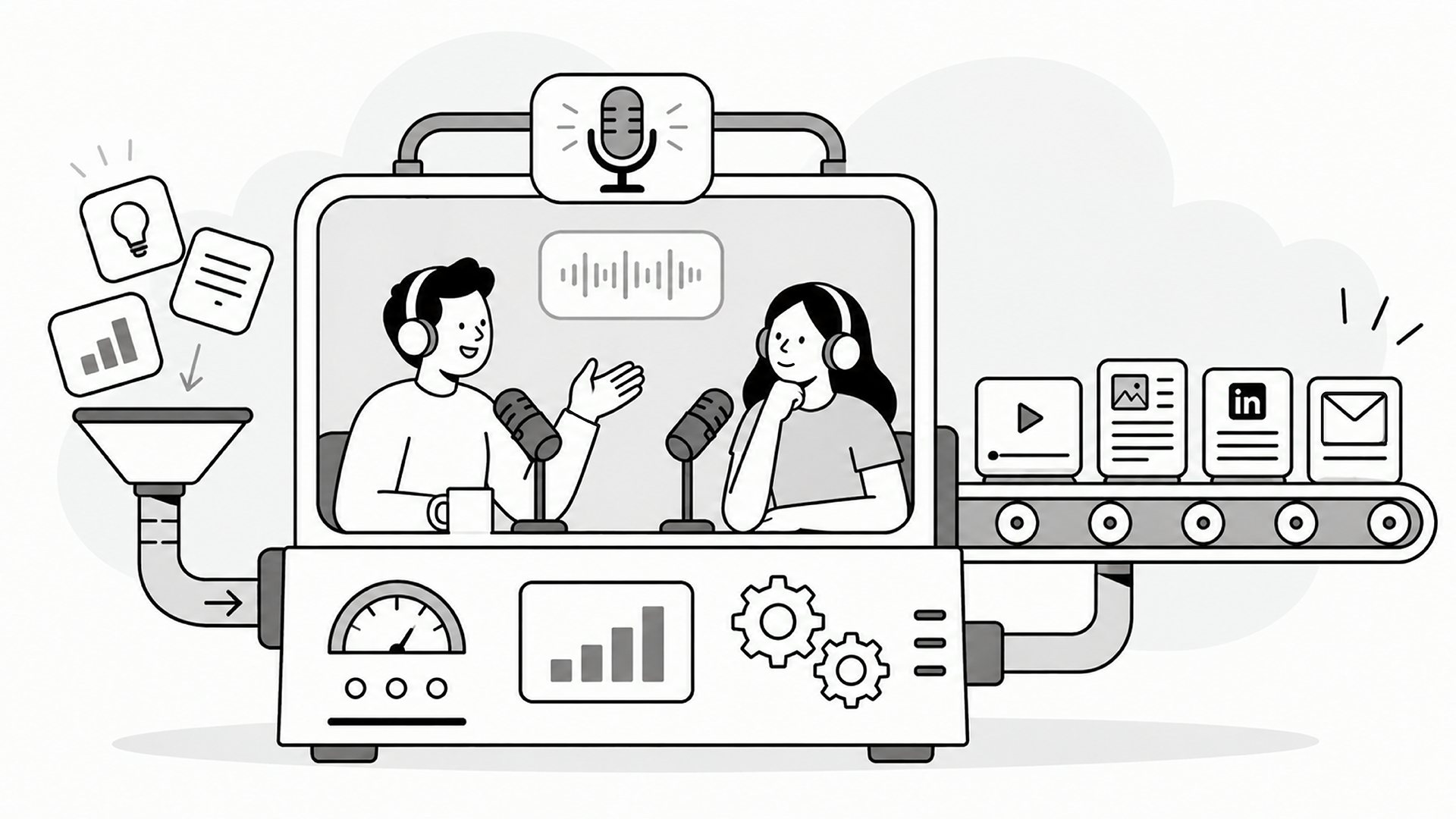
The fix is rarely complicated, but it does require clarity. Strong shows are built around a problem worth owning, not a topic broad enough to fill airtime. They have a point of view that shows up consistently, not hot takes, just coherence and sharpness in how the host frames trade-offs. They also respect the listener’s time, which usually means tighter starts, less filler, and editing that keeps the conversation moving. And they don’t treat distribution as an afterthought: the episode is the deep work, but the summaries, clips, and shareable moments are what let the thinking travel inside the niche.
Do those few things well, and the podcast stops being “content”. It becomes a platform people return to and a brand asset that compounds.
Where this fits for a B2B company (and how we help at Heltr Skeltr)
If you’re a B2B company, a podcast is one of the few brand assets that lets people experience your thinking, not just read your claims. Over time, it shapes what you’re known for: the problems you understand, the standards you hold, and the point of view you bring to the category.
That’s the branding play, and it’s why this format can be so powerful. The right listeners don’t just remember an episode. They start to remember you as the team that explains the space clearly, asks better questions, and doesn’t default to buzzwords.
At Heltr Skeltr, we build podcasts as brand platforms. We help you develop a distinct voice, a clear editorial point of view, and a show identity that feels unmistakably yours. The goal isn’t “content.” It’s association: when people in your niche think about the category, your perspective is the one that comes to mind.